


















CARBONDALE, Ill. — State officials from the Illinois Department of Human Services and the Office to Prevent and End Homelessness held a town hall and listening session at 3:30 p.m. Wednesday, Feb. 25, at First Presbyterian Church in Carbondale to share statewide strategies and gather feedback on how to address homelessness.
Christine Haley, Illinois’ first chief homelessness officer, opened the event with a presentation on housing instability, including people staying temporarily with others because they cannot afford housing and people who rely on shelters or live outdoors.
Haley highlighted racial disparities in homelessness. The state’s Home Illinois plan, citing the 2023 Point-in-Time count, says Black Illinoisans made up 47% of residents experiencing homelessness despite making up 15% of the state’s population. Illinois Department of Public Health materials say Black Illinoisans are almost eight times more likely to experience homelessness than white Illinoisans.
The presentation introduced Home Illinois, the state’s interagency plan to prevent and end homelessness. The plan outlines over 125 state actions. It is organized around four strategies: building affordable and permanent supportive housing, bolstering the safety net, securing financial stability and closing the mortality gap. The plan also reports a 154% increase in state funding dedicated to homelessness programs, rising from $211 million in FY23 to over $546 million.
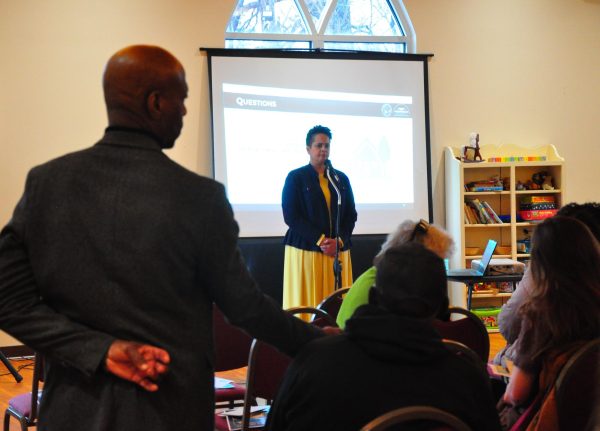
“We believe that all people need a home, and that all people should be able to thrive in their homes,” Haley said.
The second portion of the event focused on audience input, guided by questions from OPEH.
Victor Ludwig, a Carbondale resident, said direct donations have been key in helping meet basic needs in the community.
Maryam MirRiahi, another Carbondale resident, urged state leaders to pair community concern with structured support.
“People have a lot of feelings of wanting to help the homeless, but without direct organization from the state of Illinois, their good intentions have no real direction,” MirRiahi said. “We need to pair this community with real programming and funding to address this obviously large population. That cannot be solely addressed with food pantries and warming centers and must include more fortified organization at the state level.”
Mike Tyson, the regional capacity developer for the Southern Illinois Resource and Advocacy Center, said the region’s data collection system can be outdated, which can affect how need is measured and how resources are planned.
“The people living on the streets have a lot of health problems. They’re not going to be able to hold a job down,” said Eileen Irvin-Trout, a former associate professor in Southern Illinois University’s School of Allied Health. “But when they’re in a supervised setting where their meds are monitored, they can function.” Irvin-Trout, now retired, said the region needs more group homes and larger facilities, and she pointed to warming centers as an example of needed capacity.
After the session, Dianah McGreehan, director of violence prevention programs for the city of Carbondale, said the event was part of the city’s effort to build a coordinated approach.
“They had been doing a lot of outreach and communication across the state,” McGreehan said, referring to IDHS. “I thought it was really important that they speak to the research that already exists from a statewide lens and also talk some strategies that individuals are taking.”
“There’s been a really big call to action for the city of Carbondale to create a strategic vision and addressing homelessness with the interagency approach,” she said. “We haven’t been able to establish that yet, but I think with today’s information and with the voices in this room, from our citizens and residents, hopefully that guides us in that direction.”
Feedback from the session will be shared with state officials as they continue planning and implementation, McGreehan said.

